The repository with the all the code and some examples can be found here
If you're just interested in the results, take a look here , or here for the algorithm I used with a mostly line-by-line explanation as to what's going on. More thorough information as to why that's going on can be found just before
Background
To my knowledge, the fastest solver for sudukos, of all calibers, is Tom Dillon's solver. As outlined in a post authored by him, he approaches the puzzles as constraint satisfaction problems.
Omitting a good deal of techniques that Tom uses to make approach the fastest, the solver uses the DPLL algorithm to attempt to find states for all the literals (the candidates of a sudoku puzzle) that satisfy a given set of clauses. It should be noted that the "conventional" Sudoku constraints - only one candidate per row|column|box - are not represented explicitly in these clauses, but implicitly through more complex constraints and the use of what Tom calls "triads" which, to reduce their simplicity substantially, group up some literals and help to make the application of techniques like "locked-candidates" quicker and simpler.
The key to speed
All that said, a propositional approach to Sudoku like Tduko's only reduces the amount of "guessing" a solver does; the propositional approach, triads and all, is still slow compared to the other solvers out there, like JCZsolve for example. The key to the speed of Tduko, is in C's bitvectors and the SIMD operations that can process bitvectors unbelievably fast.
Representing all of the above using bitvectors and restricting operations on these bitvectors to exclusively SIMD operations, Tduko has both the reduced search length as a result of the quick and accurate guessing, but also the speed to dominate all the other solvers. Unfortunately... Python does not have the finesse of a langauge like C that would make a chasing a propositional approach like Tom's massively feasable. It could be done, but it'd be messy and likely much slower than a simpler approach.
Representing all of the above using bitvectors and restricting operations on these bitvectors to exclusively SIMD operations, Tduko has both the reduced search length as a result of the quick and accurate guessing, but also the speed to dominate all the other solvers.
Unfortunately... Python does not have the finesse of a langauge like C that would make a propositional approach to Sudoko solving very practical, as compounding lots of constraints
Another approach
Taking a step back from this therefor, the next best thing would be something a little more simple, like backtracking search or more specifically the Dancing Links algorithm. Whilst DLX is fast, to my knowledge, when pitted against a slightly modified backtracking search, it won't perform quite as well. Peter Norvig demonstrated that a solver need not be complicated or use an algorithm like DLX, nor written in a "lower-level" of a language like C to perform aptly. I tested this solver, and it was able to solve most puzzles in less than a second, with some notable exceptions where it took 60x as long.
TL;DR: My approach and implementation
My approach therefor, is a simple algorithm - an implementation of the "solver-basic" solution as proposed by Tom here - backtracking, combined with a simple search heuristic optimised for Python and all it's nitpicks:
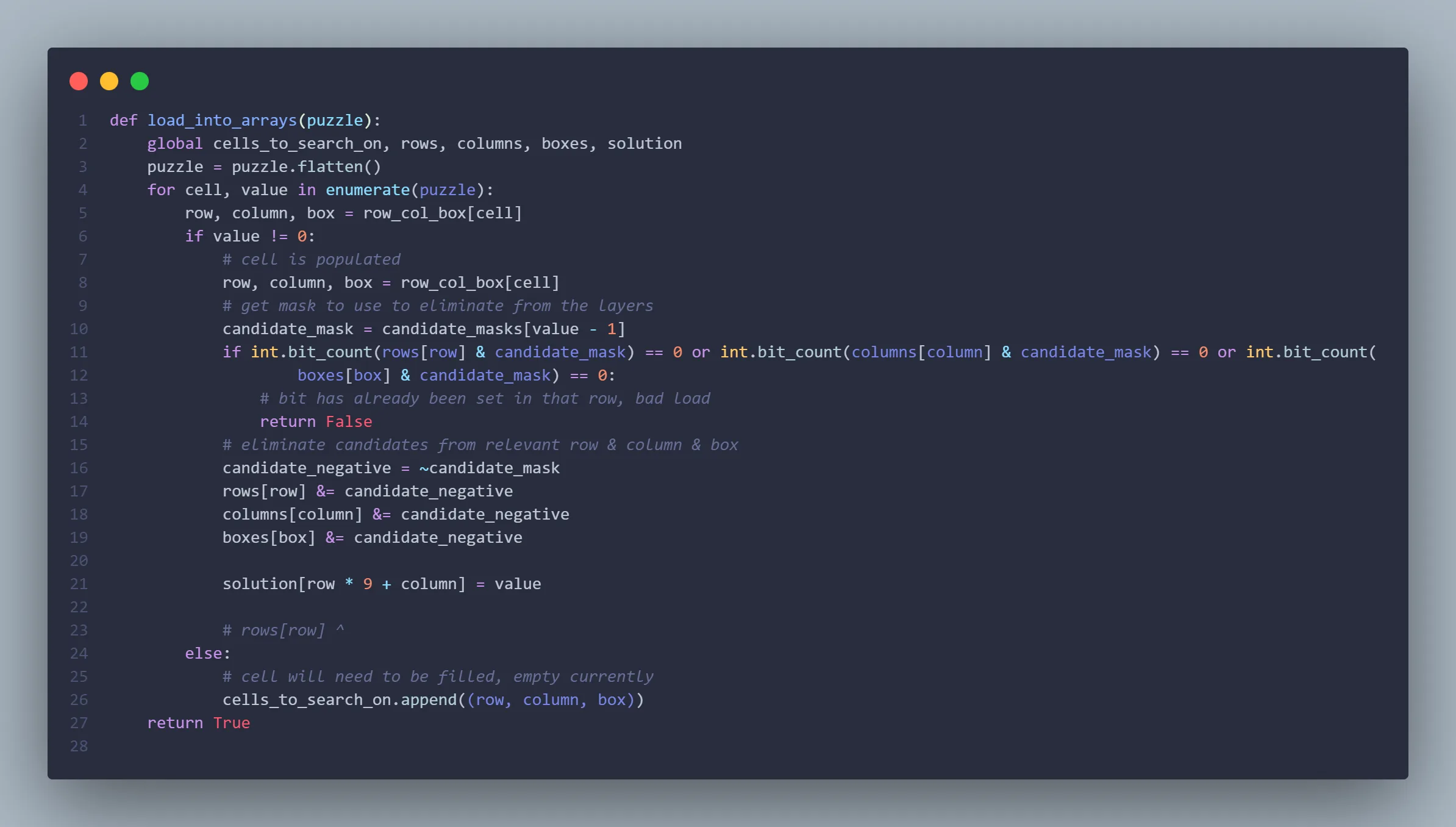
- Storing each of the rows, columns, and blocks as a 9 bit integer, where a set bit represents that a candidate has yet to be placed in that row|column|box. For example, at the 2nd least significant bit on the far right of the integer, a set bit means that a 2 has yet to be placed in that row, column, or box. The only operations required to complete the search in a timely manner, namely picking the next cell and candidate to propagate with and eliminating the candidate from other cells, can be done using bitwise operations exclusively, which is thankfully something Python can manage fairly quickly.
- Each iteration of the search, we sort the remaining empty cells by the number of candidates that can be placed in said cells - this is the part of the search which takes place the most, and also takes the longest - thankfully, storing information about the candidates that can be placed in a cell as the aggregation of the possible candidates in their row, column, and box makes this easy. For any given cell we can AND its row, column, and box binary number together count the number of set bits left. That is, the number of candidates that can possibly be placed in that cell. Next, we take the first item in the cell-todo list (with the least amount of possible candidates) before assigning a possible candidate to that cell, "marking" it as done in the todo list, and then calling the search function recursively on this new puzzle state. Note that this means we propagate on any singles here, just as you would when you do a Sudoku puzzle yourself. Other solvers might look for these cells explicitly, whereas here it's a natural byproduct of the sorting process. If puzzle reaches a point where the first item in that sorted list of cells to fill has 0 candidates, it can be deduced that some assignment up the call stack was wrong - backup and try a different candidate. Otherwise, the search continues until the todo list is completed and a solution has been found.
Implementation
Implementing this approach in Python, I tested a good variety of tweaks, very few of which actually served to improve anything.
For example, the arrays were never big enough to warrant using Numpy arrays with their O(1) lookup times considering the overhead associated with using them; strings were sometimes preferable to lists as their "deepcopy" is apparently infinitely more efficient in this context. This means however, that I would be restricted exclusively to string manipulation as an operation, which would inevitably result in more instances of iteration than desired; a significant time boost could be yielded through the use of C coded python extension modules like GMPY, but alas that is outside the scope of this project as such modules are not part of the standard Python library.
I also tried various heuristic modifications: when used in conjunction with the row-column-block data structure, sure, things like searching for hidden-singles or locked-cells is possible, but those tasks are not remotely practical as the data structure just does not lend to the approach whatsoever. The only alteration that could be made to the search heuristic without compromising on its speed, would be to look for full, or almost-full, houses - when a column|row|box only has one or two cells left to place, providing an ample opportunity for speedy propagation. It would only make sense to search for these situations if every cell had ~3 candidates at minimum per the preliminary sort (therefor finding a full or almost-full house would provide some actual benefit in propogation), which happens *some* of the time. Having that happen in conjunction with having a row|column|box in the aforementioned state however... Over thousands of the hardest puzzles, just it just doesn't happen. At all. This potential modification to the heuristic can be written off.
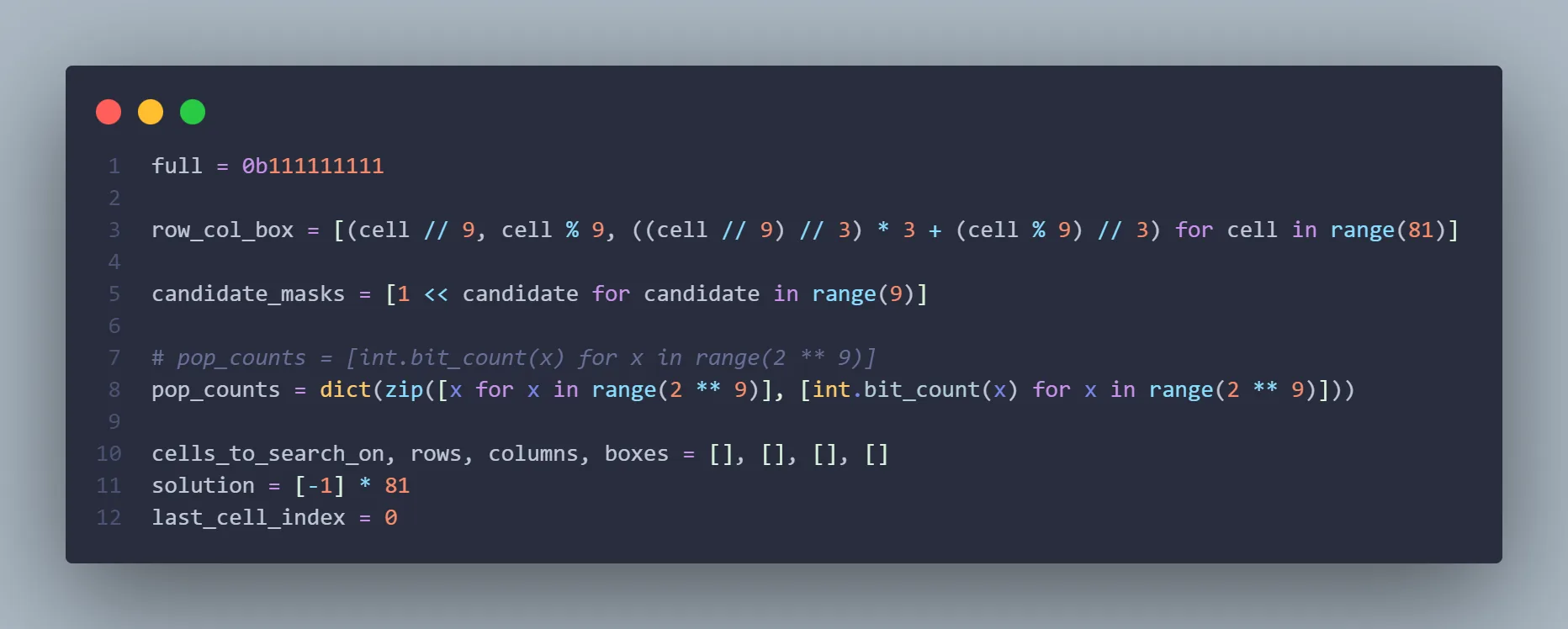
Some changes did make a difference though. For example, simple things like using lookup tables in the form of a dictionary were far superior a Numpy list, regular list, or the builtin method for counting the set bits in a binary integer:  If all else fails, try and hash it!
To conclude, it seems to me that what makes fast-solvers fast, is not the search itself or what they use as a heuristic, but the use of datastructure(s) implemented in a langauge that makes sense given the context, which in turn gives the programmer a little leeway in regard to how they guide the search - hidden-singles or otherwise.
Code
Set up the presets, global variables, and lookup tables:
Load the puzzle into the array:
And the main propogate and search function:
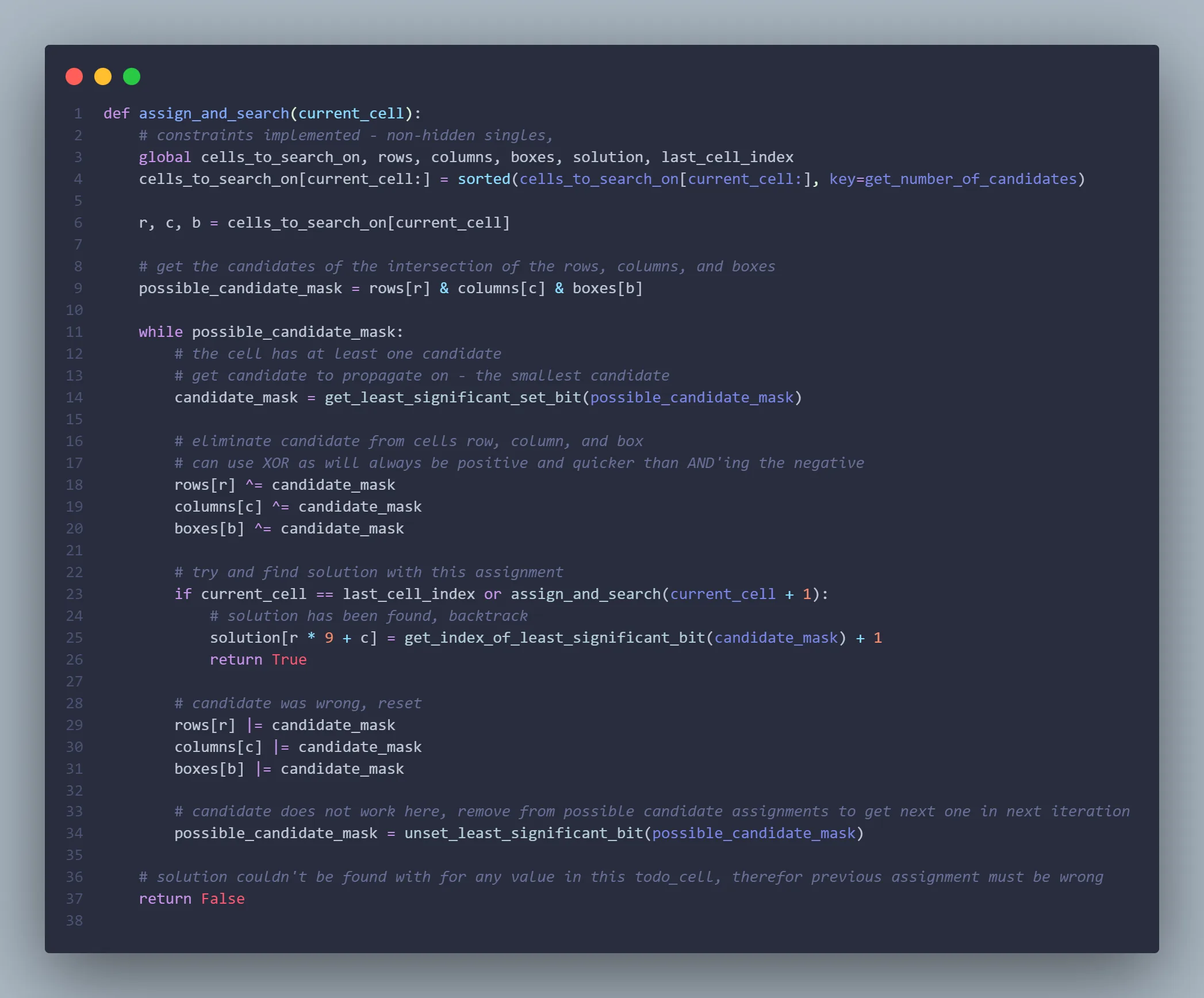
- Sort the cells that need to be filled by the number of candidates each cell has
- AND the rows, columns, and boxes together to get the combination of candidates that might be placed in that cell. If possible_candidates = 0 then there are no candidates remaining.
- Get the row, column, and box of the next cell to be sorted (has the least available candidates)
- If candidates exist, start looping through possible options:
- Get the mask of the least significant bit - I.e the smallest candidate.
- Remove that candidate from row, column and box.
- Call the method recursively to continue the search - if either this is the last cell to fill, or the search has returned True fill in the cell in the solution, and backup
- If the search does not return True, return the candidate as a possibility and backup.
Results
A bit of googling led me to the Sudoku Enjoyers forum thread where various contributors developed Tduko's main competition JCZsolve, as well as compiled thousands upon thousands of the hardest puzzles that strained Sudoku solvers the most.
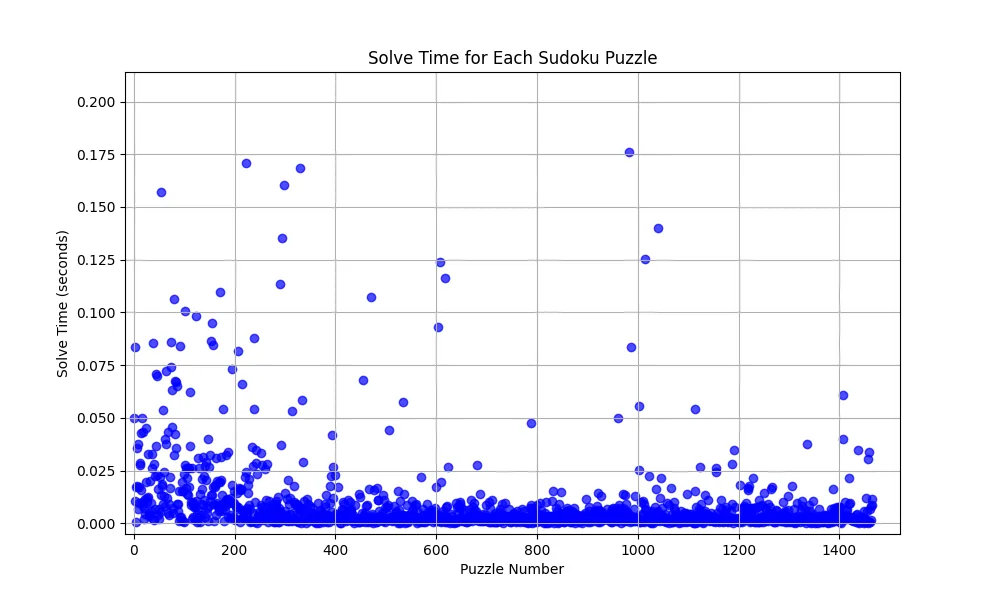
Running these puzzles past my solver allowed me to gradually tweak and test the aforementioned adjustments across thousands of test-cases. On average, my solver would solve the puzzles in ~0.04 (+-0.02) seconds, with some taking ~0.5 seconds at worst - I assume these were just puzzles that had suboptimal guessing paths, where the solver might propagate down a path to a great depth, find an issue, backtrack and do it all over again, many, many times until coming to the actual solution. This might be fixed by adjusting the heuristic somewhat, but 0.5 seconds is more than acceptable, so I left it as is.
The solve times of the MagicTourTop1465 - an collection computationally difficult puzzles that's frequently used as a benchmark. As you can see, a vast majority of the solve times are under the 0.02-0.01 second threshold, but some drag the average up nonetheless: